Beguines
Midwinter BreakThe Beguines are a Catholic sisterhood whose distinctive promise, as the novel explains it, is a religious life without permanent vows. Their historical example matters to Stella because it suggests that faith and women’s independent lives need not be separated from the ordinary world. The Amsterdam Begijnhof makes that possibility tangible, while Stella’s search for a community closer to home tests whether its model might still be available to her.
Origins and Way of Life
Stella learns that the Begijnhof began in medieval times as a home of the Beguines. She describes the women as living alone like nuns, but without vows: they could return to the world and marry if they wished. This account distinguishes their way of life from a permanent religious commitment. Religious devotion does not require them, in her telling, to make their future irrevocable.
The distinction is practical as well as spiritual. When Stella explains what she has been told about a possible religious community, she stresses that it would not be a convent or a life of seclusion. Women could have a place of their own without taking a vow of poverty. The novel presents this arrangement as a form of religious belonging compatible with personal independence, rather than as a simple withdrawal from ordinary life.
The Begijnhof as a Place
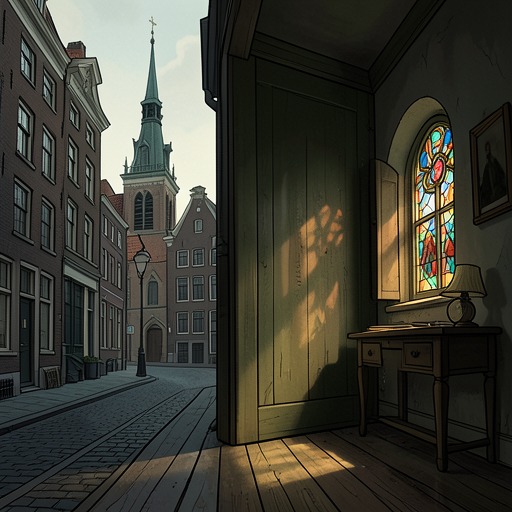
The Begijnhof’s architecture gives Stella’s interest a particular setting. Its enclosed grassy space is surrounded by old Dutch houses with decorated gables; the buildings lean toward one another, and their hoist beams rise above the rooflines. Gerry sees a secluded, bowl-like space filled with light. These features make the place feel distinct from the city around it without turning it into an abstract ideal: it is a lived environment of houses, paths, a church, and shared religious signs.
Stella points out the doorway where she made her inquiries, calling them matters of life and death. At the centre of the green stands a statue of Christ with hands directed toward his heart, an image Gerry recognizes from the computer screen Stella had left before their trip. Nearby, a veiled female figure in a walking pose proves to be a statue of an early Beguine. Stella notices her raised hand lifting her dress and admires her as a woman getting things done. The image links religious identity not only to contemplation but to movement and activity.
Stella also recalls the guidebook’s account that the site was once below sea level and frequently flooded. In her reading, the Beguine figure’s practical energy sits naturally beside a history of inhabiting difficult ground. The sanctuary feeling she finds there is therefore bound to a material place and the work of living in it, not merely to an idea of escape.
Stella’s Search
Stella’s interest predates this visit. On an earlier trip to Amsterdam, she heard that the Begijnhof might suit women who wanted to live a religious life. She wondered whether other places like it existed closer to home. During the present visit, she makes inquiries and arranges to speak on Monday with a Spiritual Director. Her questions concern origins and the possibility of a contemporary community, not simply the history of the buildings.
The plan unsettles Gerry, who briefly fears that Stella has arranged the trip to tell him bad news. She reassures him that this is not the case, but insists that the matter is important. Her description of a religious community—neither convent nor seclusion, and without a compulsory vow of poverty—makes clear that she is seeking a specific kind of life, not just a visit to a historic site. Gerry’s confusion and Stella’s insistence establish that her inquiry is consequential even before its outcome is known.
Faith in Daily and Shared Practice
The Beguine tradition appears alongside Stella’s existing religious practices. Gerry unexpectedly sees her kneeling beside the bed in her white nightdress, praying. Her routine moves through prayers for family and thanks for her life and survival, then extends to refugees and people fleeing war. She regards some of this repeated prayer as spiritual tidying, a morning-and-evening practice that orders the world in her mind. The scene shows devotion as something maintained through private, habitual action, not only through formal vows or membership in a community.
A Christmas memory also presents Stella participating in the public life of the Church. She serves as a Eucharistic minister with Sister Francis, receiving communion at the altar and then dispensing hosts from a gold chalice. Gerry watches her from the pew and recognizes that he does not fully know this part of her. The episode does not establish her as a Beguine; rather, it places her interest in the sisterhood within a broader religious life already expressed through prayer and service.
Possibility and Limitation
The search does not resolve into Stella joining a Beguine community. At the airport, she says that an all-female religious collective is no longer an option. She then connects the practical future of the couple’s flat to Gerry’s promise to give up drinking: if he keeps his word, selling it may not be necessary. The novel thus places Stella’s search beside the marriage’s material and emotional circumstances, without claiming that either can simply replace the other.
Gerry answers her appeal with the beginning of the phrase All shall be well, and Stella prompts him to continue. The exchange brings a religious expression into the couple’s immediate negotiation, but leaves its assurance conditional on what they do next. The Beguines remain significant less as a destination Stella reaches than as a model she investigates: a form of faith organized around women’s lives, a dwelling of one’s own, and commitment without an irreversible vow.